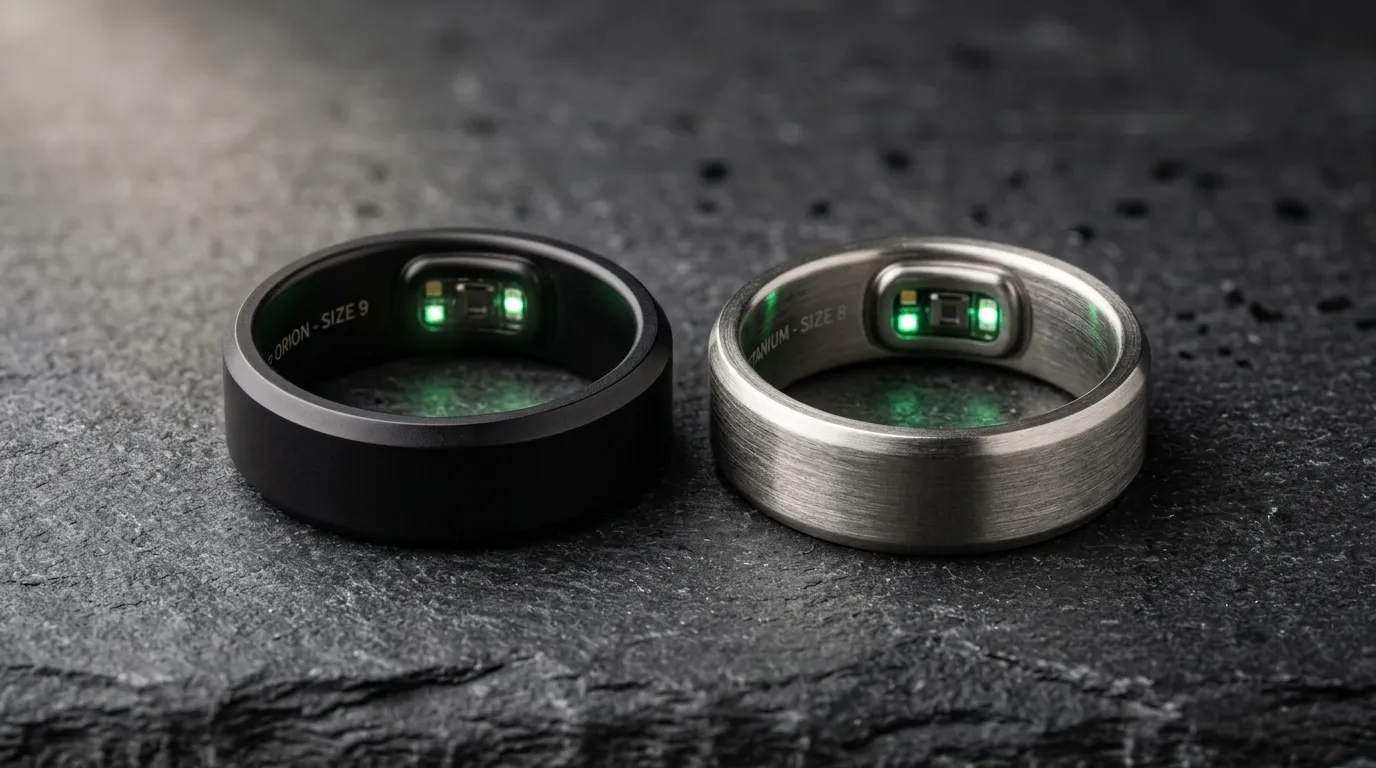
Miniaturizing biomedical telemetry into a finger-worn form factor requires balancing severe physical constraints: micro-amperage power budgets, motion artifact rejection, photoplethysmography (PPG) optical coupling, and irreversible lithium-polymer battery wear curves. Over nine months of parallel telemetry collection, I evaluated the Oura Ring Gen 3 and the Ultrahuman Ring Air across identical physiological workloads.
This technical deep-dive breaks down the hardware physics, sampling duty cycles, rMSSD mathematical modeling, continuous glucose monitoring (CGM) Bluetooth bridges, and long-term ownership economics of both platforms.
Hardware Architecture & Financial Commitments
While both form factors look identical externally, their sensor layouts and operational cost structures diverge substantially:
| Hardware & Business Metric | Oura Ring Gen 3 | Ultrahuman Ring Air |
|---|---|---|
| Hardware Cost | $299 (Heritage) / $349 (Horizon) | $349 |
| Subscription Model | $5.99 / month ($71.88/yr mandatory for raw sleep/HRV metrics) | $0 / month (Lifetime telemetry & API access) |
| Weight & Inner Shell | 4.0–6.0g (Molded epoxy resin inner) | 2.4–3.6g (Tungsten carbide coated titanium) |
| CGM Metabolic Telemetry | Indirect (Apple Health / Health Connect sync) | Direct Bluetooth pairing (Ultrahuman M1 / Abbott sensors) |
The total cost of ownership (TCO) over a standard 3-year hardware lifecycle highlights the financial divide: Oura Gen 3 totals $515 to $565 USD when factoring in the mandatory subscription, whereas the Ultrahuman Ring Air remains fixed at $349 USD.
Sensor Physics: PPG Sampling, Photodiodes & rMSSD Mathematics
Both devices measure pulse rate and autonomic nervous system activity through Photoplethysmography (PPG), but their sensor duty cycles and optical architectures differ substantially:
- Overnight HRV Calculation (rMSSD): During sleep, both rings operate continuous infrared PPG sensors at 50 Hz sampling frequency, combined with a 6-axis 3D accelerometer for real-time motion artifact rejection. If finger movement exceeds acceleration thresholds (> 0.05g), the epoch is marked corrupt and discarded from the inter-beat interval (IBI / RR-interval) calculation. Heart Rate Variability is modeled via Root Mean Square of Successive Differences (rMSSD):
Overnight resting posture minimizes motion artifacts, allowing both devices to achieve 92–96% correlation with gold-standard Holter ECG monitors for nocturnal rMSSD trends.
rMSSD = sqrt( (1 / (N - 1)) * sum( (RR[i+1] - RR[i])^2 ) ) - Active Daytime Sampling Rates: Oura conserves power by cycling green PPG LEDs in low-power spot-check mode (1–2 Hz bursts every 5 minutes), unless an active workout or guided meditation is initiated. Ultrahuman samples daytime heart rate and skin temperature at higher continuous duty cycles, calculating moving baseline medians every 60 seconds. This provides richer daytime autonomic stress curves at the expense of roughly 15–20% faster battery depletion.
Lithium-Polymer Chemistry & Battery Degradation Realities
The primary physical limitation of all smart rings is the miniaturized 15mAh to 22mAh lithium-polymer pouch cell sealed within the titanium casing:
- Charge Cycling Degradation: Because the battery capacity is minuscule, smart rings undergo a full 0–100% equivalent charge cycle every 4 to 6 days. Over 24 to 30 months (approx. 200–300 full cycles), cell capacity naturally degrades by 25–40%.
- Unrepairable Sealed Enclosure: Unlike smartphones or smartwatches with accessible gasket seals, smart ring batteries are permanently encapsulated in resin for 100m water resistance. When the battery cell reaches end-of-life, the hardware cannot be serviced or battery-swapped; the entire ring must be replaced.
- Charging Hygiene: To maximize cell longevity, maintain charge levels between 20% and 80% using short 15-minute daily charging top-offs during morning showers rather than leaving the ring overnight on the charging puck.
Continuous Glucose Monitoring (CGM) Integration Architecture
For metabolic health optimization, the Ultrahuman platform bridges ring biometrics with interstitial glucose sensor telemetry (Abbott FreeStyle Libre sensors via NFC/Bluetooth):
- Metabolic Score Correlation: Ultrahuman’s software overlays glucose spikes (postprandial glucose excursions) directly against real-time heart rate and movement data. If an engineer eats a meal that triggers a 160 mg/dL spike followed by an HRV plunge and elevated resting pulse, the app calculates a personalized Metabolic Recovery Index.
- Oura’s Ecosystem Approach: Oura does not manufacture CGM hardware. Users seeking metabolic correlations must export Oura data to Apple Health and ingest it into third-party subscription platforms like Levels or Supersapiens, introducing multi-app subscription overhead.
Data Governance & Health Record Security
- Biometric Data Export: Both Oura and Ultrahuman provide structured JSON/CSV data exports via user web portals, allowing engineers to ingest raw sleep stages and HRV time-series data into local Jupyter notebooks or homelab InfluxDB dashboards.
- Bluetooth Low Energy (BLE) Security: BLE advertisement packets are encrypted during active syncing to prevent local packet sniffers from harvesting raw physiological telemetry in public environments.
Frequently Asked Questions (FAQ)
1. What is the real-world battery life between charges?
In standard production usage: Oura Gen 3 delivers 5 to 6 days when new (declining to 3–4 days after 18 months). Ultrahuman Ring Air averages 4 to 5 days due to higher daytime PPG sampling frequency. Both devices recharge from 20% to 100% in roughly 45 to 60 minutes.
2. Can smart rings replace dedicated sports watches for workout tracking?
No. Finger vasoconstriction during heavy lifting and rapid motion artifacts during running degrade ring PPG accuracy to 80–85% compared to chest-strap ECGs (Polar H10). Smart rings are optimized for nocturnal recovery and passive baseline tracking, not high-frequency athletic telemetry.
3. How resistant are the titanium shells to abrasive wear?
Both rings use grade titanium outer coatings, but contact with knurled steel gym equipment (dumbbells, barbells) will produce cosmetic micro-scratches. Removing the ring during heavy deadlifts or kettlebell training is recommended to protect sensor casing integrity.
Engineering Verdict
If your priority is a mature, clinically validated sleep staging algorithm with extensive longitudinal research backing, and the ongoing $5.99/month subscription is acceptable, the Oura Ring Gen 3 remains a reliable baseline.
If you require zero recurring subscription fees, lower hardware weight (2.4g), direct metabolic CGM telemetry integration, and an open platform approach, the Ultrahuman Ring Air offers superior hardware economics and metabolic observability.