In mid-2025, an indie SaaS founder ran a painful $4,000 experiment. He hired an agency to generate 200 technical comparison articles using standard Generative AI (GPT-4o chat completions + prompt chains). The result was disastrous: 45 articles hallucinated non-existent CLI flags, 80 articles linked to dead 404 URLs, and the tone was so uniformly robotic that Google's quality classifier deranked the entire subdomain within six weeks.
Generating text is easy. Executing reliable business outcomes is brutally hard.
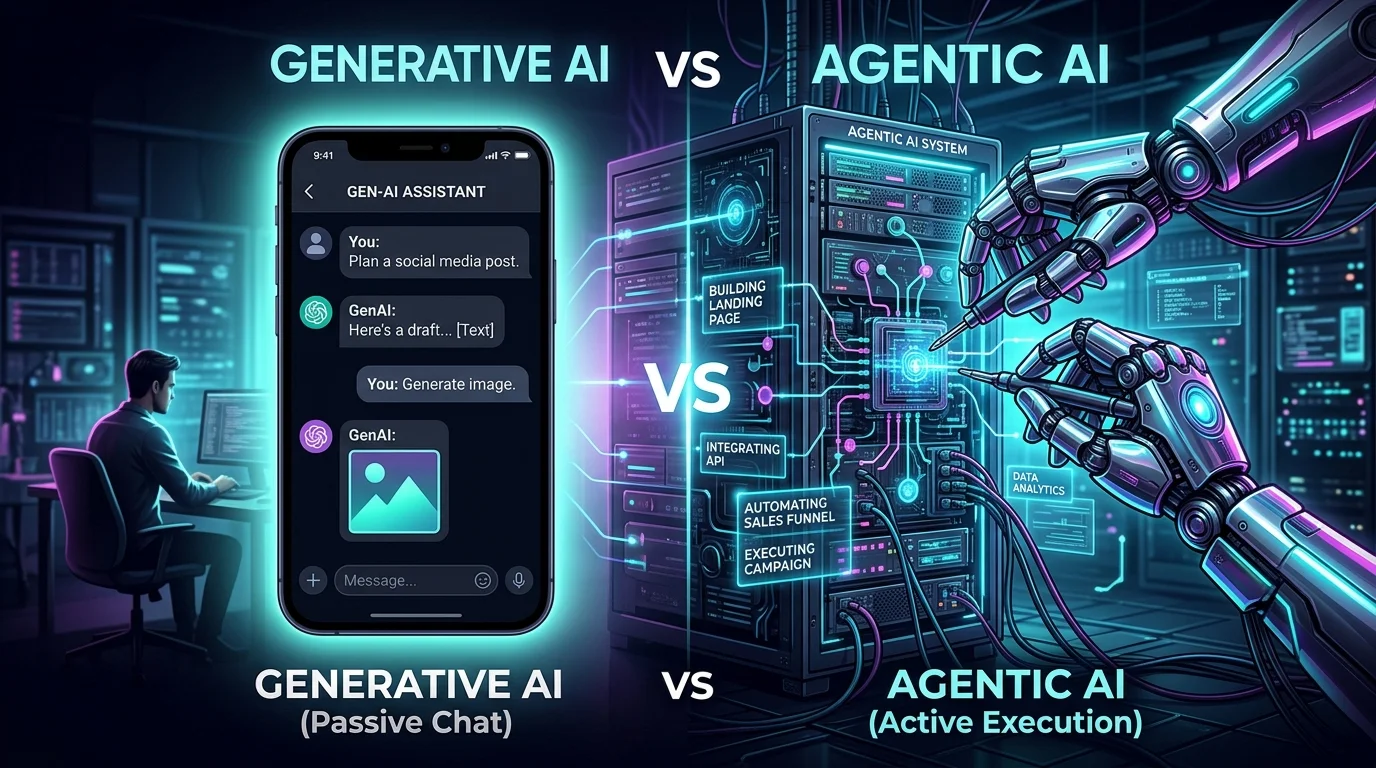
The difference between Generative AI and Agentic AI is the difference between a chatty intern who writes eloquent essays without checking facts, and an autonomous engineer who queries your production database, validates JSON schemas against strict Pydantic models, and executes state-machine rollbacks when an API fails. For solopreneurs and technical founders in 2026, understanding this distinction is the dividing line between burning API credits and building scalable one-person operations.
The Structural Divide: Static Completions vs State Machines
To understand why generative AI fails at complex tasks, you must look at how each system interacts with state and external environments.
1. Generative AI: Open-Loop Text Prediction
Generative models (ChatGPT, Claude web UI) operate as open-loop statistical predictors. You pass a prompt string; the model generates the most statistically probable sequence of output tokens and halts. It has no awareness of whether the code it wrote compiles, whether the customer email it drafted actually sent, or whether the price calculation it performed is mathematically correct.
[User Prompt] → [LLM Completion] → [Raw String Output] → (Human must copy/paste & execute)2. Agentic AI: Closed-Loop ReAct Cycle (Reason + Act)
Agentic systems wrap language models inside a deterministic execution harness (using frameworks like LangGraph, CrewAI, or n8n). The LLM is not the entire application—it is merely the reasoning engine inside a state machine.
1. Observe Environment (Read Webhook / SQL DB)
2. Reason & Plan (LLM generates tool call arguments)
3. Execute Action (Execute REST API / Run Script)
4. Evaluate Result (Validate JSON schema with Pydantic)
   └→ If Error: Self-correct and retry with modified parameters
   └→ If Success: Advance state machine to next node
The 4 Architectural Pillars of Production AI Agents
Building an agent that doesn't hallucinate into your production systems requires four foundational layers:
1. Strict Tool Call Schemas (Pydantic / Zod)
Never parse raw markdown or regex from LLM outputs. Production agents enforce JSON schemas using structured tool calling (OpenAI function calling or Claude Tool Use). If an LLM returns a string when an integer ID is expected, the runtime validator intercepts the error and forces an immediate self-correction loop.
2. Deterministic State Persistence (Postgres / Redis)
If an agent fails mid-execution during step 7 of an 8-step migration workflow, it must not restart from step 1. Modern agentic architectures save execution checkpoints to disk or database tables, allowing seamless resumes and zero duplicate API charges.
3. Token Budgeting & Max-Loop Guardrails
An unconstrained agent in an error loop can consume $50 in OpenAI credits in 10 minutes. Production harnesses enforce strict max_iterations=5 limits and token budgets per execution run.
4. Human-in-the-Loop (HITL) Gateways
High-consequence actions (issuing refunds > $100, dropping database tables, emailing VIP clients) trigger a paused state, sending an interactive Slack/Telegram confirmation button to the founder before executing.
Direct Comparison: Generative vs. Agentic Paradigms
| Operational Dimension | Generative AI (Chatbots / Prompts) | Agentic AI (Autonomous Pipelines) |
|---|---|---|
| Execution Nature | Passive (Requires manual copy-paste) | Active (Executes REST APIs & DB Queries) |
| Trigger Mechanism | Synchronous human prompt in UI | Event-driven (Webhooks, Cron, Kafka, DB CDC) |
| Error Handling | Silent hallucination (Fails invisibly) | Self-correcting ReAct retry loops + alerts |
| Unit Economics | Billed per interactive query ($20/mo SaaS) | Flat VPS infrastructure + metered LLM tokens |
Practical Case Study: The Solopreneur Customer Support Agent
Here is what a production agent looks like in practice using a hybrid self-hosted n8n instance connected to a local vector store and Stripe webhook:
- Ingestion: Customer opens a support ticket via Typeform or email.
- Triage & Embedding: The agent generates vector embeddings of the user's inquiry and performs semantic search over pgvector documentation tables.
- Deterministic API Checks: If the user asks for an invoice change, the agent queries the Stripe API to verify the customer's subscription tier and billing status.
- Drafting & Validation: The LLM drafts a contextual, personalized resolution email with direct deep links.
- Execution / HITL: If the issue involves money (> $50 credit), the agent sends a rich card to the founder's Telegram bot:
[Approve $50 Credit] | [Reject]. If approved, the agent executes the Stripe credit API and dispatches the email.
This single pipeline eliminates 85% of tier-1 support tickets without ever hallucinating invalid account actions.
Frequently Asked Questions
Will Agentic AI completely replace Generative AI?
No. Generative AI is the cognitive language processor inside Agentic AI. You cannot have an agent without a generative LLM to interpret unstructured text and reason over tool options. Agentic AI simply provides the execution framework around the generative brain.
What is the biggest failure point when building AI agents?
Unbounded loops and loose output parsing. Without strict JSON schema validation (Pydantic/Zod) and maximum iteration caps, an agent encountering an unexpected API error will loop infinitely, burning tokens and potentially spamming external endpoints.
Do I need Python to build production agentic workflows?
Not necessarily. While Python frameworks like LangGraph and CrewAI offer fine-grained code control, visual orchestration platforms like n8n allow solopreneurs to build fully deterministic, event-driven agentic pipelines with JavaScript code nodes and built-in error triggers.